The real difference today is not “portable vs. not portable” anymore — it’s how much power a device is willing to trade for battery life and a built-in screen, and whether it’s designed to plug into a TV as its primary use case or as an optional extra. Everything else follows from that one tradeoff.
A decade ago the answer to this question was easy. A home console sat under a television, drew power from a wall socket, and had no screen of its own. A handheld had a small screen, ran on batteries, and was noticeably weaker because it had to fit in a pocket and sip power instead of gulping it. Those categories don’t map cleanly onto the current hardware landscape, and that’s the whole reason this question keeps coming up.
§01Is there still a real technical difference between handhelds and home consoles?
Yes, but it’s a difference of degree, not of kind. Home consoles still generally out-power handhelds because they aren’t constrained by a battery or a body that has to stay cool in someone’s hands. Handhelds make a series of compromises — in graphical detail, in how hard the processor is allowed to run, in screen resolution — to stay portable.
This isn’t a new idea; it’s the same tradeoff that’s existed since the earliest handhelds, just compressed into a smaller gap. Where a 1990s handheld was a full generation behind the home hardware of its day, a modern hybrid or portable device is often running the same architecture family as its home counterpart, just clocked lower and rendering at reduced detail to protect battery life and heat output. The category difference used to be architectural. Now it’s closer to a dial being turned down.
Readers who want the deeper mechanics of why hardware generations matter at all, separate from this handheld question, may find our piece on console generation vs. console refresh useful background, since a lot of the same logic about “same family, different tier” applies here too.
§02What does “hybrid” actually mean, and does it change the category?
A hybrid console is a handheld that can also connect to a television through a dock, effectively letting one device serve both roles. It blurred the handheld/home console line more than any single piece of hardware before it, because ownership no longer implies a fixed way of playing.
Before hybrids became common, owning a handheld and owning a home console were separate purchases for separate situations. A hybrid design collapses that choice: the same cartridge or downloaded game can be played in bed, on a train, or docked to a big screen, often without the player noticing much difference beyond screen size. This is the biggest reason the phrase “handheld vs. home console” feels dated to a lot of players — the two are no longer mutually exclusive categories of ownership, just modes of use.
It’s worth noting that docking usually asks more of the display connection than people expect. If a hybrid is going to spend most of its life connected to a TV, it’s worth understanding what that TV can actually do with the signal — our guide on whether you need a 4K TV for a modern console covers this from the display side, and the explainer on what HDMI 2.1 actually changes for gaming is relevant if a household is shopping for a TV around a docked device rather than a traditional console.
§03Why does a home console still outperform a handheld running the same game?
Home consoles don’t have to manage a battery, they have more room for cooling, and they draw continuous power from the wall instead of a finite cell. That headroom is spent on higher detail, steadier performance, and less aggressive downscaling of the image.
A handheld chip doing the same job as a home console chip has to throttle itself to avoid draining the battery in an hour or overheating in someone’s hands. Manufacturers usually respond by lowering resolution, simplifying lighting or effects, and capping how hard the hardware is allowed to work. This is why the same game often looks and feels slightly different depending on which format it’s running on — not because the game changed, but because the hardware underneath made different compromises to survive outside a wall socket.
None of this means handheld hardware is “worse” in a way that should discourage buying it — it means it’s optimized for a different job. A shopper trying to decide which tradeoff suits them is really making a buying-advice decision as much as a technical one, and our buying advice hub has more on how to think through that kind of tradeoff for a specific household.
§04Does storage and loading work differently on handhelds?
Handhelds have historically relied more on physical cartridges and slower internal storage than home consoles, though many modern handhelds now include fast internal storage similar in principle to what’s in home consoles. The practical difference today is mostly about capacity and expandability, not raw technology.
Home consoles have moved toward solid-state storage as standard, which is a genuinely significant change from the hard-drive era — it’s covered in detail in our explainer on what an SSD actually changes about game loading. Handhelds increasingly use similar solid-state components internally, just smaller in capacity, which is why storage anxiety hits handheld owners sooner. A useful gut-check for either format is our guide on how much console storage you actually need, since the answer depends more on install sizes and how many games are kept installed at once than on whether the device is portable.
§05Do handhelds and home consoles use the same controllers?
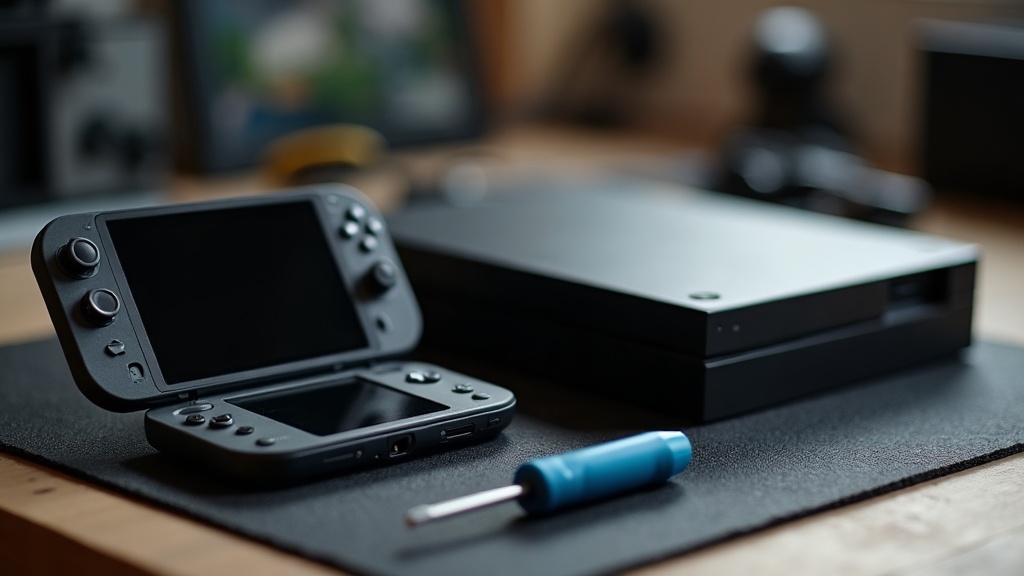
Home consoles use a separate wireless controller, while most handhelds build the controls directly into the device body. Some hybrids let players detach or add controllers, which puts them somewhere in between.
This matters more than it sounds like, because built-in controls on a handheld are fixed in size and layout — they can’t be swapped for a different grip the way a home console controller can. It also changes how wear shows up. A home console controller with worn sticks can simply be replaced; a handheld with the same problem for its built-in controls generally can’t be fixed by buying a new peripheral. Anyone troubleshooting drifting or unresponsive sticks on either type of device may want to read what controller drift actually is and why it happens, and for the more general mechanics of how any of these controls register a press, how game controllers actually track inputs explains the underlying sensors involved.
§06Which one lasts longer — a handheld or a home console?
Neither format has an inherent lifespan advantage; longevity depends more on build quality, how the device is treated, and battery health than on whether it’s a handheld or a home console. Handhelds do carry one extra failure point that home consoles don’t: a rechargeable battery that degrades over years of use regardless of care.
A home console left in a media cabinet has no equivalent wearing part, but it does accumulate dust, and its internal cooling has to work over years of continuous use, particularly if it’s rarely powered down. A handheld gets carried around, dropped, and charged repeatedly, all of which stress different components. For a broader look at what actually causes hardware to fail over time in either category, the site’s guide on how long a game console actually lasts before it fails goes into the common failure points in more depth.
§07So does the handheld vs. home console label still mean anything?
It still describes a real tradeoff — power and screen size versus portability and battery life — but it no longer describes two separate ecosystems of hardware and games the way it did in earlier hardware generations. The label survives as a description of use case more than a description of what’s inside the box.
That shift matters for buying decisions. Choosing between a handheld-first device and a traditional home console today is less about which one is “better” and more about matching the tradeoff to how someone actually plays — on a couch in front of a television, in short sessions away from home, or some mix of both through a dock. It’s also worth factoring in timing: hardware revisions tend to fix early rough edges in both categories, and the general reasoning in buying at launch versus waiting for a revision applies just as much to handhelds as it does to home consoles.
For anyone still weighing the decision, the consoles and hardware hub is a reasonable next stop, since most of the individual factors — controllers, storage, displays, and durability — end up mattering more to day-to-day satisfaction than which broad category the device technically belongs to.