Neither format is simply “better” — physical games tend to hold resale value and survive service shutdowns, while digital games win on convenience and avoid disc rot or lost cases. The right answer depends on whether you value long-term ownership or day-to-day ease of use more.
§01What actually happens to a game over 10 or 20 years?
Over a long enough timeline, physical media and digital licenses fail in different ways. A disc can degrade, get scratched, or simply go missing from a shelf. A digital purchase can become unplayable if a storefront shuts down, a publisher delists it, or the servers that validate your license go offline.
Neither risk is hypothetical. Storefronts have closed before, and older physical media from earlier console generations is known to degrade in ways that make some discs unreadable decades later. The difference is that a damaged disc is often still a physical object you can inspect, clean, or replace secondhand — a delisted digital game usually isn’t recoverable at all.
§02Does buying physical games actually save money long-term?
Physical games can save money long-term mainly through resale and price drops on the used market, something digital purchases generally can’t offer. Digital games sometimes go on deeper discount during sales, which can offset that advantage depending on timing.
The used market is really the deciding factor here. A physical copy retains some trade-in or resale value, and buying used lets you pay less for the same disc later. Digital licenses are tied to your account and typically can’t be resold at all, so their price only ever moves in one direction: down, during a sale, at the platform’s discretion.
If you’re weighing a used purchase against a fresh digital copy, it helps to know what to actually inspect before handing over money. Our guide on what to check before buying a used game covers disc condition, case contents, and code redemption issues that can quietly turn a “used” bargain into a bad deal.
§03Is digital better for convenience?
Yes — digital games remove the need to swap discs, dig through a case pile, or worry about scratches, and most modern libraries can be reinstalled on demand. That convenience is real, but it depends entirely on stable internet and continued storefront support.
For anyone with a large library, not having a shelf of cases is genuinely useful. There’s also the update angle: digital games patch automatically in the background far more smoothly than physical releases, which often still require a large day-one download anyway. In practice, many “physical” purchases in the current generation aren’t fully offline experiences at all — the disc is closer to a license key with some of the data already on it.
§04What about storage space?
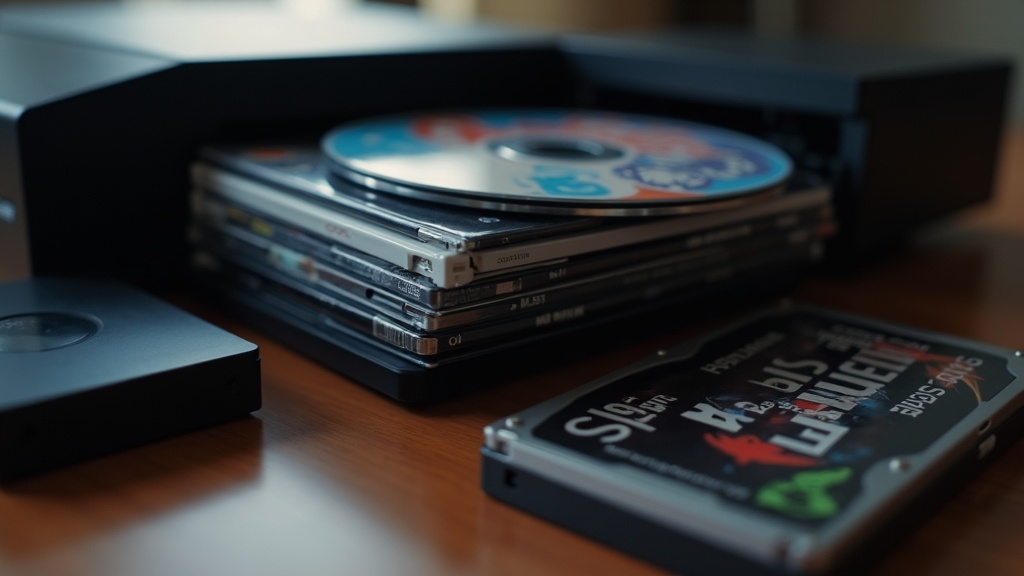
Digital libraries are limited by your console or PC’s internal and expandable storage, while physical libraries are limited by shelf space and card slots. Neither is unlimited, but digital storage is the one you’ll actually run out of first on most modern consoles.
Modern games have grown large enough that even a generous internal drive fills up faster than most people expect, especially once you start keeping several big titles installed at once. It’s worth understanding how much console storage you actually need before assuming a digital-only approach will be painless. Deleting and redownloading a large game whenever storage gets tight is also a lot slower than swapping a disc, an experience that becomes more obvious once you’ve felt what an SSD actually changes about game loading compared to spinning storage.
§05Which format preserves better for the future?
Physical media generally preserves better because a disc or cartridge can, in principle, still be read decades later with the right hardware, even after a platform is discontinued. Digital licenses depend on servers staying online, which is entirely out of the owner’s control.
This is really the heart of the “game preservation” conversation that comes up whenever an older platform’s online store is wound down. A physical collection sitting on a shelf doesn’t need permission from anyone to keep working — you just need a working console, which is its own challenge as hardware ages. Our piece on how long a game console actually lasts before it fails is a useful companion read if you’re building a physical collection you expect to still play in ten years.
Emulation and legal preservation efforts are part of this conversation too, but that’s a separate, more complicated topic from simply deciding what to buy today — and it’s worth treating carefully rather than as a shortcut around either format.
§06Do subscription services change the calculation?
Subscription services complicate the digital-vs-physical debate because they offer neither true ownership nor a permanent library — games rotate in and out, and access ends if you cancel. They’re a third option, not a replacement for either buying method.
For some players, a subscription is genuinely better value than buying outright, especially for trying a wide range of games without committing. For others who want to keep a specific title indefinitely, neither digital purchases nor subscriptions match the simple permanence of an owned physical disc. We break this down in more detail in are game subscription services actually good value?, which is worth reading before assuming a subscription solves the ownership question.
§07Does the console generation matter to this decision?
Yes — some consoles ship without a disc drive at all, which removes the physical option entirely, while others support both formats side by side. Checking which version of a console you own (or are buying) matters before assuming physical is even available to you.
It’s also worth understanding the difference between a full generational leap and a mid-generation hardware refresh, since refreshes sometimes change disc drive availability or storage configurations without being a new console family. Our explainer on console generation vs. console refresh covers that distinction, and if you’re choosing between hardware versions at all, buying a console at launch or waiting for the revision is a related decision worth thinking through at the same time.
§08What about PC gaming — is the calculation different there?
On PC, the physical option has mostly disappeared for new releases, and digital storefronts are the default rather than one choice among several. The long-term consideration shifts from disc versus download to which storefront and account ecosystem you’re comfortable relying on for years.
PC libraries also depend more heavily on your own hardware choices — storage capacity, drive speed, and how you manage a growing collection over time. If PC is where most of your buying happens, our PC gaming and setup hub is a good starting point for the storage and performance side of that decision, alongside how much RAM a gaming PC actually needs if you’re building or upgrading a system to hold a larger library.
§09So which should you actually buy?
There’s no single right answer, but a reasonable rule of thumb: buy physical for games you expect to want in ten years and might resell, and buy digital for games you’ll play once, want the convenience of, or that aren’t available physically at all.
Collectors, retro enthusiasts, and anyone wary of storefronts disappearing tend to lean physical wherever it’s still offered. Players who prioritize convenience, frequent sales, and not managing a shelf of cases tend to lean digital, often supplementing with a subscription service for games they don’t need to keep. Either way, it helps to think about the purchase the same way you’d think about any other piece of gaming gear — with resale, longevity, and how you actually play in mind. Our buying advice hub has more guides built around exactly that kind of long-term thinking, and the consoles and hardware hub covers the physical side of the equation in more depth.