Online multiplayer became normal through a slow stack of small fixes: home internet got fast and cheap enough to matter, consoles built networking into the hardware instead of treating it as an accessory, and developers stopped seeing “play with strangers” as a niche feature and started building whole games around it. No single moment caused it — it was a decade of infrastructure catching up to an idea PC players already loved.
§01When did people first play games online?
People were connecting computers to play games together as early as the 1970s and 1980s on university networks and bulletin board systems, long before “online gaming” was a marketing term. These were text-based games and slow, text-heavy setups running over phone lines, accessible mostly to people with institutional access or a lot of patience.
The more recognizable starting point for consumer online play came in the 1990s, when home modems became common enough that PC gamers could dial into services or directly into each other’s machines. Multiplayer at this stage usually meant typing in a friend’s number, waiting through a connection handshake, and hoping the call didn’t drop halfway through a match.
This era lived entirely on PC. Consoles of the same period were built as closed boxes — a cartridge or disc went in, and the only “multiplayer” was local, on a shared screen or with cables running between machines in the same room. The idea of a console phoning out to the internet wasn’t part of the design.
§02Why did PC gaming get online multiplayer first?
PC gaming got there first because personal computers already had modems, expansion slots, and operating systems built for general networking tasks, while consoles were purpose-built game machines with no such plumbing. Developers on PC could bolt networking onto existing hardware; console makers would have had to design it in from scratch.
Early PC multiplayer took a few different forms:
- Direct dial-up connections between two modems, with no server in between
- Local area network play, common in offices, dorms, and organized LAN parties where people hauled desktop towers to a shared location
- Early internet matchmaking services that helped players find opponents without knowing their phone number
Shooters and real-time strategy games became the proving ground for this. They didn’t need much data to communicate — mostly player positions and actions — which made them realistic to run over the slow connections of the time. This laid technical groundwork that would matter later, but it also created a cultural expectation: PC gamers came to see internet play as a normal thing a game might offer, while console players still saw it as unusual.
§03What changed the equation for consoles?
Consoles moved from optional add-on internet support to online being a core, expected feature over the course of two console generations, driven mainly by broadband becoming common in homes and manufacturers deciding networking had to be built into the hardware rather than sold as an accessory.
Early console attempts at going online were tentative. Some systems offered modem or broadband adapters as separate purchases, and a handful of games supported online play as a bonus feature rather than a headline one. These attempts proved the idea worked but didn’t make it mainstream — buying extra hardware just to try online play was a barrier most people skipped.
The real shift came when a console generation shipped with networking built in as standard, alongside a proper online service layer: accounts, friends lists, matchmaking, and a way to buy games and add-ons digitally. Once that existed as a default rather than an option, developers could assume almost every buyer had the capability, and design around it instead of treating it as a bonus mode.
This lines up closely with a broader hardware story worth understanding on its own — the move from console generation to console generation often changes far more than graphics power, and connectivity is one of the clearest examples. Readers interested in that bigger picture can look at how a console generation differs from a console refresh, since online infrastructure is one of the things that usually only changes at a full generational jump.
§04How much did broadband internet actually matter?
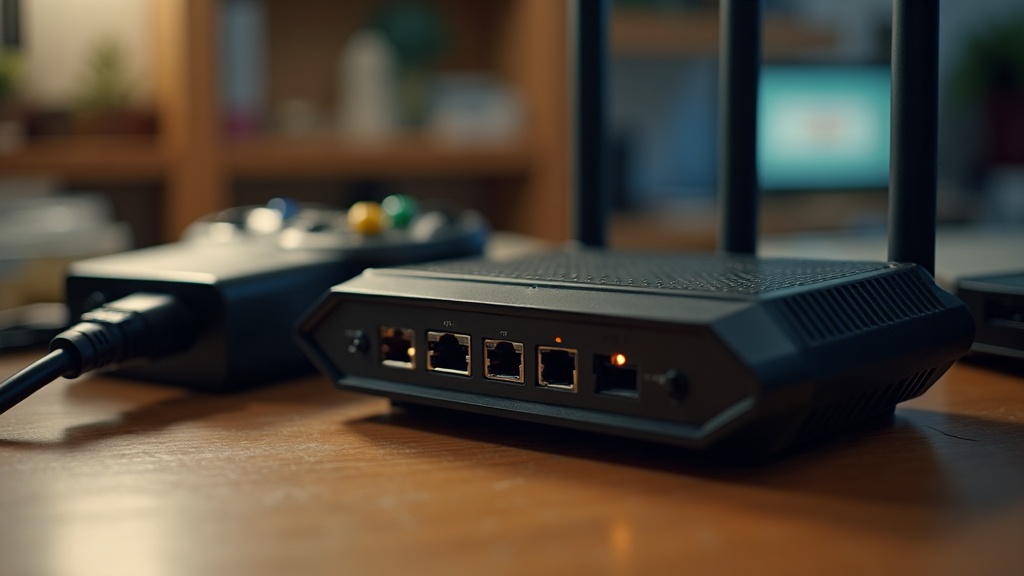
Broadband mattered enormously — it removed the two biggest obstacles of the dial-up era: tying up the household phone line and dealing with connections too slow and unstable for real-time action games. Once broadband spread into ordinary homes, online play stopped being a special-occasion activity and became something people could leave running in the background.
Dial-up had structural problems that no amount of clever game design could fully work around. A connection could drop mid-match, the household phone was unusable while someone was gaming, and the delay between an action and its result on screen made fast-paced competitive games frustrating. Broadband didn’t eliminate lag entirely, but it lowered it enough, and made connections stable enough, that online play stopped feeling like an experiment.
It’s worth remembering broadband adoption itself took years to spread unevenly across regions and income levels. Online multiplayer becoming “normal” wasn’t a single global switch flip — it happened first in areas with strong broadband infrastructure and spread outward from there, at different speeds in different countries.
§05Why did online services start charging for something LAN play used to give free?
Console makers began charging subscription fees for online multiplayer because running the servers, matchmaking systems, and account infrastructure at a national or global scale costs money on an ongoing basis, unlike a one-time LAN connection between two nearby machines. The fee model funds servers that need to run continuously, not just during a single match.
This is a genuinely contested point among players. Some argue that since much of the actual game traffic runs peer-to-peer rather than through expensive dedicated hardware, the fees are mostly profit rather than a direct pass-through of server costs. Others point out that matchmaking, account security, cloud saves, and anti-cheat systems all require constant infrastructure investment regardless of how any single match is routed, and that free monthly game downloads bundled into these services offset some of the cost for subscribers.
Both positions have merit, and there’s no neutral, verifiable number that settles the argument — it depends on internal cost structures companies don’t publish in detail. What’s clear is that the subscription model became normal alongside online play itself, so for most players today the two are inseparable: paying a recurring fee for network access is simply part of owning a modern console, the same way game subscription services have become part of the wider buying calculation.
§06How did game design change once online play became standard?
Once online multiplayer became a reliable default, developers stopped treating it as a bolt-on mode and started building entire games, business models, and long-term support plans around it. Live service games, seasonal content, and persistent online worlds only make sense once a studio can assume most players are connected.
Some of the clearest shifts:
- Games began shipping with post-launch patches and balance updates, something impossible on cartridge-era hardware
- Matchmaking and skill-based pairing replaced the informal “find a friend with the same phone number” era
- Voice chat and friends lists became built-in social layers rather than third-party add-ons
- Some titles moved to being sold as ongoing services rather than one-time purchases, with content added over years
This also changed how games age. A single-player game on an old cartridge or disc still works exactly as it did on release, which is part of why retro preservation is a manageable, if unglamorous, task. An online-dependent multiplayer game, by contrast, can effectively stop existing the moment its servers are switched off — a preservation problem that didn’t really exist before online play became the norm.
§07Did any earlier hardware changes set the stage for this shift?
Yes — the broader move from cartridges to discs, and later the arrival of consoles with internal storage and network ports as standard, made online features practical in ways cartridge-only hardware simply couldn’t support. Patches, downloadable content, and persistent online accounts all needed storage and connectivity that early console generations lacked entirely.
It’s a useful reminder that “online multiplayer becoming normal” wasn’t an isolated event. It rode on top of other infrastructure changes that are easy to overlook, including the same disc-based storage shift covered in our piece on what the shift from cartridges to discs actually changed, and the general trend of consoles getting more capable, quieter computers inside them as each generation matured, discussed in our look at why consoles get quieter and cooler later in their life cycle.
§08What does this mean for people buying hardware today?
For today’s buyers, it means internet connectivity and online service subscriptions are no longer optional extras to weigh — they’re baked into the cost and experience of owning a modern console or gaming PC. Budgeting for online play, and understanding what a subscription actually includes, is now a normal part of the buying decision.
A few practical points worth keeping in mind:
- A wired connection is still generally more stable for competitive online play than Wi-Fi, which matters more for latency-sensitive games than for casual ones
- Console online subscriptions vary in what they bundle — free monthly games, cloud saves, and multiplayer access aren’t always packaged the same way
- Anyone buying a used console or older system should check whether its online services are still active, since some older platforms have had their online infrastructure retired over time
Readers weighing a new setup can find more grounded detail in our buying advice section, and anyone assembling or upgrading a PC specifically for online play may want to start with our overview of PC gaming and setup basics, since a stable connection and reasonable hardware matter more for online multiplayer than raw graphical power ever will.
§09The short version
Online multiplayer didn’t arrive with one product launch — it built up over roughly two decades, from dial-up experiments on PC, through consoles slowly adding optional network features, to broadband and built-in networking making online play the default rather than the exception. What started as a curiosity for a small, patient group of PC players became the assumed way most people play games together, and the industry’s business models, live-service games, and even its preservation challenges have been reshaped around that shift ever since. For a wider look at how gaming hardware evolved around it, our game history archive covers the surrounding pieces of that story.