A graphics card is a separate, dedicated piece of hardware with its own processor and memory built solely to render images. Integrated graphics is a much smaller graphics processor built into the CPU itself, sharing the system’s regular memory. The graphics card is more powerful; integrated graphics is cheaper, cooler, and uses far less power.
Both are trying to do the same basic job: turning game data into an image on the screen. But how they’re built, and what resources they get to work with, changes almost everything about how well they handle modern games.
§01What exactly is a graphics card?
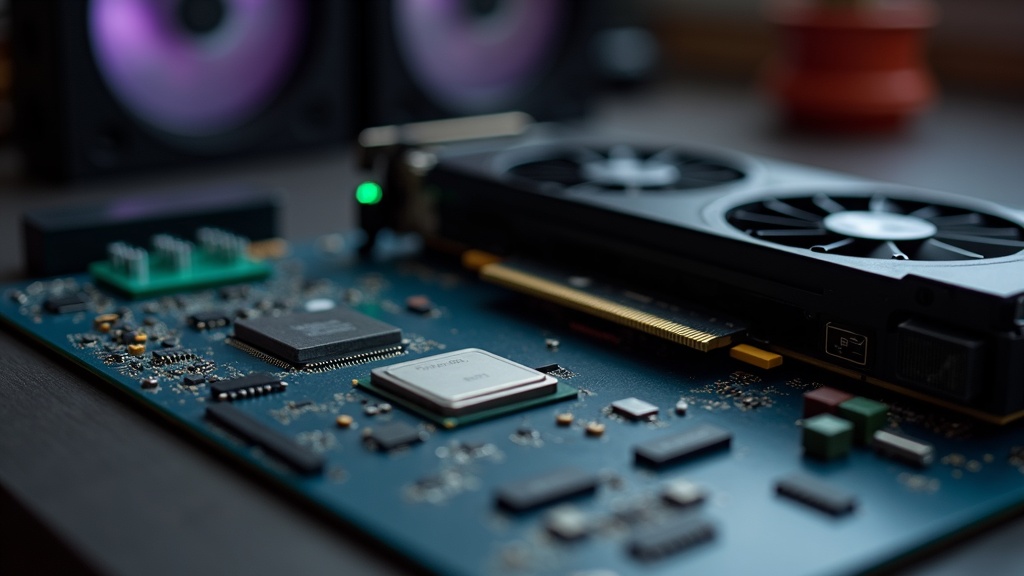
A graphics card, also called a GPU or a video card, is a physical add-in component that slots into a PC’s motherboard. It has its own processor (the actual “GPU” chip), its own dedicated memory, its own cooling fans or heatsink, and its own power connection separate from the rest of the computer.
Because it’s a self-contained unit, a graphics card can be built much bigger and more powerful than anything that would fit inside a CPU. It has:
- Its own video memory (VRAM), reserved entirely for graphics tasks and not shared with anything else running on the PC
- A far larger number of processing cores dedicated purely to rendering
- Its own cooling system, often several fans or a large heatsink, because it generates significant heat on its own
- A direct power connection to the PC’s power supply, since it draws more electricity than the motherboard slot alone can provide
This is the kind of component enthusiasts mean when they talk about “upgrading the GPU” — pulling one card out and slotting in a newer one, without touching the rest of the PC. For a broader look at how this piece fits with the rest of a build, see our guide on what gaming PC parts matter most for the money.
§02What is integrated graphics, exactly?
Integrated graphics is a graphics processor built directly onto the same chip as the CPU, rather than existing as a separate part. Instead of dedicated memory, it borrows a portion of the computer’s regular system RAM to do its job, and it shares cooling and power with the CPU itself.
This approach is common in laptops, budget desktops, and most prebuilt office-style computers. It exists because not every computer needs serious graphics horsepower — a machine used for browsing, spreadsheets, or word processing doesn’t benefit from a large, power-hungry graphics card.
The tradeoff is capacity. Because integrated graphics shares memory with everything else the computer is doing, and shares a thermal and power budget with the CPU, it simply cannot be built as large or as fast as a dedicated card. It’s a compromise designed around efficiency and cost, not peak performance.
§03Why does a graphics card perform so much better?
A graphics card outperforms integrated graphics mainly because it has dedicated memory, dedicated cooling, and dedicated power — none of which it has to share with the CPU or the rest of the system. That extra headroom lets it push far more detail, at higher settings, more consistently.
Think of it like the difference between a dedicated workshop and a corner of the garage. Integrated graphics is working in a shared space, competing for the same memory and the same power and thermal limits as the processor handling everything else in the system. A graphics card gets its own dedicated space to work, built specifically for one job.
This shows up in a few practical ways for a game running on each:
- Higher and more stable detail settings, since there’s more processing power and memory available
- Better handling of demanding visual effects like complex lighting, shadows, and reflections
- More consistent performance during busy on-screen moments, rather than dipping when a scene gets complicated
- Support for newer graphics features sooner, since dedicated cards are usually updated on a faster cycle than integrated chips
None of this means integrated graphics is bad. It means it’s built for a different job — general computing with some light gaming capability — rather than being the primary target for demanding new releases.
§04Can integrated graphics still run games well?
Yes, integrated graphics can run many games, especially older titles, indie games, and anything with modest visual demands, but it typically requires lower settings than a dedicated card would need for the same game. Modern integrated graphics has also improved generation over generation.
Chip makers have steadily gotten better at fitting more capable graphics processors into the same CPU package, and some recent integrated chips are genuinely respectable for casual and moderately demanding games. It’s a much smaller gap than it was years ago, though it hasn’t closed entirely.
Where integrated graphics tends to struggle is with newer, graphically ambitious games that expect a lot of dedicated memory and processing power. In those cases, a player will usually need to turn down detail settings noticeably to keep things running smoothly, where a dedicated graphics card could handle the same game with far less compromise.
§05Does a graphics card matter for consoles too?
Modern consoles use a single custom chip that combines the CPU and GPU together, similar in spirit to integrated graphics, but engineered specifically for gaming rather than general computing. This is why console graphics chips punch well above typical laptop integrated graphics.
Because a console’s hardware is fixed and every game is built around exactly that one chip, developers can optimize far more tightly than they can for the huge range of PC hardware in the market. That’s part of why a console with a combined chip can still deliver strong gaming visuals despite not having a separate graphics card the way a gaming desktop does.
For readers weighing a console purchase against a PC build, our consoles and hardware coverage looks at how these systems are designed and how they age over a generation, including our explainer on console generation versus console refresh.
§06Which one do I actually need?
The right choice depends on what’s being played, not brand preference. Casual games, older titles, and everyday computing tasks run fine on integrated graphics. Demanding new releases at higher detail settings generally call for a dedicated graphics card.
A few practical questions can help narrow it down:
- Is the machine mainly for browsing, streaming video, and light or older games? Integrated graphics is likely enough, and it keeps the system cheaper, cooler, and quieter.
- Is the goal to play current, visually demanding games at higher settings? A dedicated graphics card is the more reliable path.
- Is this a laptop where battery life and portability matter as much as performance? Integrated graphics draws far less power, which usually means longer battery life away from a charger.
- Is upgrading down the line a priority? A desktop with a graphics card can usually have that card replaced later; integrated graphics is generally locked to whatever the CPU came with.
Cost is part of the equation too. A dedicated graphics card adds meaningfully to the price of a PC, and higher tiers of card push that cost up further, so it’s worth thinking in terms of entry-level, mid-range, and flagship tiers rather than chasing a specific card. Our buying advice hub and our piece on what gaming PC parts matter most for the money go into more detail on where to prioritize spending.
§07Does more graphics power mean I need more RAM too?
Not directly, but they’re related. A dedicated graphics card has its own separate video memory, so it doesn’t compete with system RAM the way integrated graphics does. Even so, the rest of the system still needs enough RAM to keep everything else running smoothly alongside it.
This is especially true for integrated graphics, since it’s borrowing from the same pool of memory the CPU and operating system are using. A system with integrated graphics and limited RAM can feel more strained than one with a dedicated card and the same amount of RAM, simply because the graphics chip isn’t fighting for that shared resource.
For a closer look at how much memory a gaming setup actually needs and why it matters, see our guide on how much RAM a gaming PC actually needs. It’s a useful companion question to ask right alongside “graphics card or integrated graphics,” since the two decisions affect each other.
§08The bottom line
A graphics card is a dedicated, powerful, separately cooled and powered component built to handle demanding visuals. Integrated graphics is a smaller, shared-resource solution built into the CPU, better suited to everyday use and lighter gaming. Neither is universally “better” — the right one depends entirely on what a player actually intends to run.
Readers setting up a new gaming PC or comparing a build against a console might also find it useful to browse our PC gaming and setup section for related buying and configuration guidance.