Rhythm games feel good because they turn a piece of music into a physical task with instant, honest feedback — press right and you feel it immediately, press wrong and you know at once. That tight loop between sound, action, and result taps into the same reward systems as playing a real instrument, but with far less friction.
§01What makes rhythm games so satisfying compared to other genres?
Rhythm games compress the gap between intention and feedback to almost nothing. In most genres, the reward for a good decision arrives seconds or minutes later. In a rhythm game, the reward arrives in the same instant as the input, synced to a beat your body already anticipates.
That immediacy is the core of it. Music primes the brain to predict what comes next, and a rhythm game turns those predictions into testable actions. When the prediction and the action land together, the brain treats it as a small win, over and over, dozens of times a minute.
- The feedback is audiovisual, not just numerical — a hit sound, a flash, a combo tick, all layered on top of music that was already engineering emotion.
- Failure is usually forgiving in the short term (a missed note rarely ends the song) but visible in the long term (the combo breaks, the score dips), which keeps stakes present without punishing exploration.
- The skill ceiling is almost entirely about timing and pattern recognition, which are easy to understand even for players who have never touched the genre before.
§02Why does hitting notes on time feel so rewarding?
Hitting a note on time feels rewarding because it closes a very short prediction loop: you hear or see something coming, you act, and you get confirmation within a fraction of a second. That confirmation loop is close to how musicians experience actually playing an instrument.
This is sometimes described using the idea of a “flow state” — a mental zone where a task is hard enough to demand full attention but not so hard that it causes frustration. Good rhythm games are built almost entirely around finding and holding that balance. The best charts (the note patterns mapped to a song) rise and fall in difficulty the same way the song itself rises and falls, so the challenge feels like part of the music rather than something bolted onto it.
There’s also a physical component. Repeated correct inputs build muscle memory quickly because the timing windows are short and consistent. Once a pattern clicks, the body seems to play it without conscious thought, which is part of why long combos in rhythm games can feel almost hypnotic.
§03How did rhythm games become a genre in the first place?
Rhythm games grew out of arcade culture, where games needed to grab attention in seconds and reward players immediately for spending a coin. That arcade DNA — instant feedback, short sessions, visible scores — is still the backbone of the genre today.
Dance and music-based cabinets became a fixture of arcades because they did something other cabinets couldn’t: they turned spectators into part of the show. A player doing well on a dance pad or a set of drum controllers was entertainment for everyone standing around, not just the person playing. That social, performative angle is part of why the genre spread so quickly from arcades into home consoles and eventually into peripheral-heavy console releases with plastic guitars and drum kits.
For more on how coin-operated design still shapes the games we play now, see our look at how arcades shaped the games we play today. The genre’s rise also overlaps with broader shifts in the industry covered in our Game History archive.
§04Why do timing windows feel different from game to game?
Timing windows feel different because each game tunes its forgiveness differently — some are generous and built for accessibility, others are punishingly tight and built for competitive scoring. Neither approach is objectively better; they’re aimed at different kinds of satisfaction.
A game with wide timing windows lets more players feel the “perfect hit” high early on, which makes the genre approachable. A game with narrow windows makes that same high much rarer and, for dedicated players, much more valuable when it happens. This is one of the genuinely contested points among rhythm game fans: some players find tight windows the whole appeal, treating the genre almost like a precision sport, while others find that same tightness turns a musical experience into a stressful reflex test. Both reactions are legitimate responses to a real design choice, not a right-or-wrong split.
Input lag matters more here than in almost any other genre, because a delay of even a tiny amount can turn a correctly timed press into a registered miss. Players chasing the tightest possible feel often care a lot about display and controller latency, topics covered in our guides on what input lag is and how to reduce it and how game controllers actually track inputs.
§05Does the hardware you use actually change how a rhythm game feels?
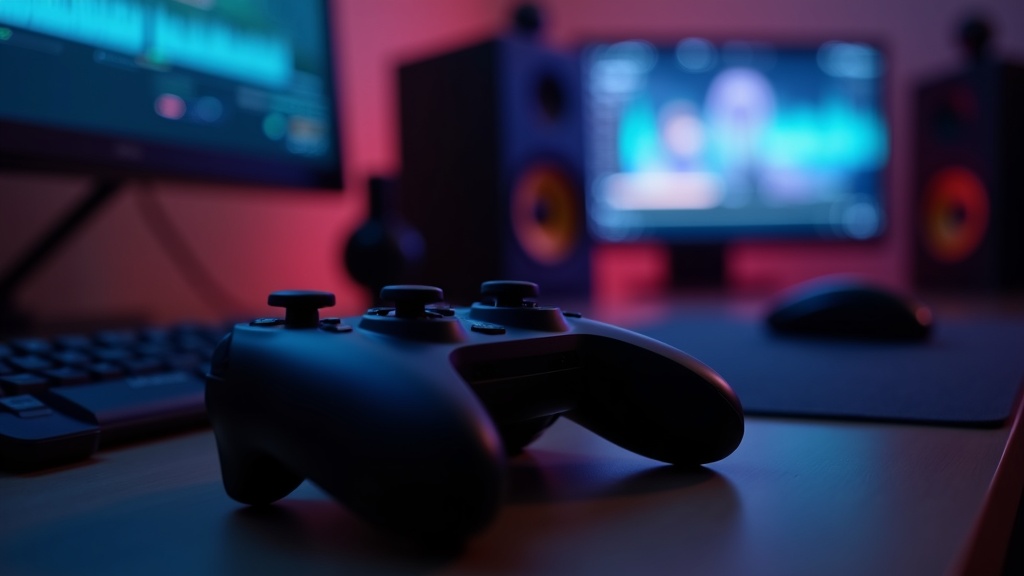
Yes — hardware changes rhythm games more than most genres, because the whole experience rests on split-second timing. A mismatched controller, laggy display, or poor audio setup can throw off the sync between what you hear, what you see, and what you press.
Some considerations that matter more here than in a typical action or strategy game:
- Audio-visual sync: if the sound and the on-screen cues drift apart even slightly, timing becomes guesswork rather than reaction. This is why many rhythm games include a calibration step, and why it’s worth actually using it rather than skipping past it.
- Display lag: a slower display path can introduce a delay between what the game sends and what you actually see, which is a bigger deal in a genre built on fractions of a second. Our piece on screen tearing and how to fix it touches on related display quirks that can throw off timing-sensitive genres.
- Controller choice: dedicated peripherals (dance pads, arcade-style button controllers, drum kits) exist because they map the physical motion of the genre more directly than a standard gamepad. Whether a specialty controller is worth buying versus adapting to a standard pad is a genuine judgment call covered in our roundup of gaming accessories worth buying.
- Headphones versus speakers: isolating the audio cue from ambient noise can make a real difference in consistency, which is part of why our guide on what a gaming headset actually does differently is worth a look for anyone taking a rhythm game seriously.
None of this means expensive gear is required to enjoy the genre. Plenty of players get the full flow-state feeling from a standard controller and a TV. But for players chasing top scores or perfect clears, hardware consistency stops being a luxury and starts being part of the skill.
§06Why do rhythm games stay fun even after you’ve mastered a song?
Rhythm games stay fun after mastery because the goal quietly shifts from “can I complete this” to “how well can I complete this,” and that second goal has almost no ceiling. Chasing a cleaner combo, a higher accuracy percentage, or a harder difficulty setting on a song you already know keeps the loop alive long after novelty wears off.
This is similar to how a musician doesn’t stop enjoying a piece once they’ve learned the notes; the challenge moves toward expression and precision. Many rhythm games lean into this directly with difficulty tiers, alternate charts, or scoring systems that reward near-perfect play differently from merely successful play. It rewards the kind of replay that other genres struggle to sustain, because the “content” isn’t new levels — it’s the same short loop, refined.
It’s also a genre that rewards short sessions extremely well, since a single song is often just a few minutes long, which makes it a natural fit for handheld play. Readers weighing handheld setups against home consoles for genres like this may find our comparison of handhelds versus home consoles today useful.
§07Is the appeal really just about music, or is something else going on?
Music is the hook, but the deeper appeal is the sense of agency it creates — the feeling that you are not just listening to a song but actively shaping how well it plays out. That blend of passive enjoyment (liking the song) and active mastery (nailing the pattern) is fairly rare in games.
Most genres ask players to overcome an obstacle that exists separately from any emotional payoff — a boss, a puzzle, an opponent. Rhythm games fuse the obstacle and the payoff into the same object: the song itself is both the challenge and the reward. Succeeding at a hard section doesn’t just prove skill, it makes the song sound and feel better in the moment, which is a satisfying trick most other genres can’t easily pull off.
That fusion is worth keeping in mind for anyone exploring genres more broadly, alongside our wider guides in the Genres & Recommendations hub, which cover how different genres create their own kinds of satisfaction — from the tension-based scares in what makes a horror game frightening beyond jump scares to the loop-based hooks explored in why survival games are so popular right now.