For most people, a good ergonomic office chair is the better long-term investment. Gaming chairs win on looks and branding, but many rely on thin padding and limited adjustability. A properly adjustable office or “task” chair usually supports posture better over long sessions, especially past the first year of ownership.
That said, “worth it” depends on budget, body type, and how many hours actually go into the chair each week. This isn’t a simple gaming-chair-bad, office-chair-good story — it’s about what each style is actually built to do.
§01What’s the real difference between a gaming chair and an office chair?
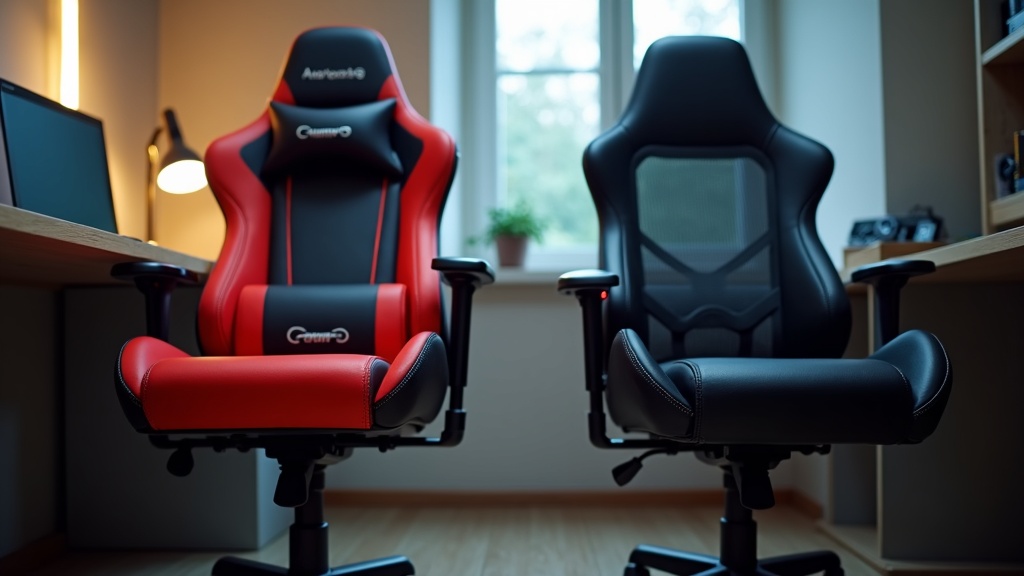
Gaming chairs are styled after racing bucket seats, with high backs, bold colors, and bolstered side panels. Office and ergonomic chairs are designed around sustained desk posture, with adjustable lumbar support, seat depth, and armrest height being the priority over appearance.
Most gaming chairs use PU leather or a leather-like synthetic covering over dense foam. That looks sleek out of the box, but foam density and covering material vary a lot between brands and price tiers. Office chairs aimed at long workdays more often use mesh backing or higher-grade fabric, which breathes better and tends to hold its shape longer under daily use.
The adjustability gap is where the categories really split. A mid-range to higher-end office chair typically offers independent lumbar height adjustment, seat depth sliding, tilt tension control, and armrests that move in more than one direction. Entry-level gaming chairs often only offer recline and armrest height, with lumbar support coming from a strapped-on pillow rather than a built-in mechanism.
§02Are gaming chairs actually bad for your back?
Not inherently, but many budget and mid-range gaming chairs lack the adjustable lumbar and seat-depth features that actually prevent slouching over long sessions. The chair’s look doesn’t reflect its ergonomic engineering, so a stylish chair can still leave lower back support inconsistent.
The bolstered side wings that make gaming chairs look aggressive are cosmetic rather than functional for most seated tasks — they don’t do much for someone sitting upright at a keyboard and mouse. The recline function, often marketed heavily, is more useful for cutscenes or console couch-style play than for active PC gaming, where an upright, supported posture matters more.
None of this means every gaming chair is uncomfortable. Some higher-tier gaming chairs use better foam and add real adjustable lumbar mechanisms, closing much of the gap with office chairs. But at the lower end of the price range, styling tends to take priority over the adjustment points that actually matter for posture.
§03Why do office chairs cost so much more at the high end?
Premium ergonomic office chairs charge for engineering, not aesthetics — multi-point adjustability, breathable mesh that holds tension over years, and mechanisms rated for heavy daily use. Gaming chairs generally spend their budget on foam volume and cosmetic stitching instead.
It helps to think in tiers rather than fixed prices, since costs shift over time:
- Entry level: Basic recline and height adjustment, limited material quality, works fine for shorter sessions or light use.
- Mid-range: Better foam or mesh, some lumbar adjustment, armrests that move in more directions, reasonable for several hours a day.
- Flagship/ergonomic-focused: Fully adjustable lumbar, seat depth, tilt tension, and armrests, built for people sitting eight-plus hours daily, often backed by longer warranties.
A flagship office chair costs more upfront largely because the mechanisms inside it — the tilt mechanism, the lumbar adjuster, the frame — are more complex and more durable than what’s found in a chair built primarily to look striking in photos.
§04Does a gaming chair make sense for anyone?
Yes — for shorter sessions, console-focused setups, or players who want a chair that visually matches a themed gaming room. A gaming chair can be a reasonable choice when comfort for hours-long stretches isn’t the main priority.
Some scenarios where a gaming chair is a fine pick:
- Playing mostly on a console from a slight recline, rather than upright at a keyboard.
- Sharing the chair between casual gaming and occasional desk use.
- Wanting a specific look for a streaming setup or gaming room, where appearance genuinely matters to the owner.
- Budget constraints where a mid-range gaming chair costs less than a comparable ergonomic office chair with similar build quality.
For people building out a full setup — desk, monitor, and peripherals — the chair is just one part of the equation. It’s worth checking a guide on how to set up a comfortable gaming desk to see how chair height, desk height, and monitor position all interact, since a great chair paired with a poorly positioned desk still causes strain.
§05How do you choose between the two for a PC gaming setup?
Base the decision on hours per day and body size rather than branding. Long daily PC sessions favor an adjustable ergonomic office chair; occasional or console-first play makes a mid-range gaming chair a reasonable, cheaper option.
A few practical questions help narrow it down:
- How many hours a day, realistically? Two or fewer hours a day makes chair ergonomics less critical. Four or more hours daily is where lumbar and seat-depth adjustment start to matter noticeably.
- Is the chair shared with work-from-home use? If it’s doing double duty as a desk chair for a job, prioritize the office-chair category regardless of gaming aesthetics.
- Does body size match the “average” chair sizing? Both categories make chairs for larger or taller frames, but it’s worth checking specific weight and height ranges rather than assuming a chair fits everyone.
- Is a warranty or trial period offered? Chairs are hard to judge from a listing alone; a return window or trial period matters more here than with most gaming accessories.
Chair choice is easy to treat as an afterthought compared to picking a graphics card or monitor, but it’s one of the few purchases that affects every single session. For a broader look at what’s actually worth spending on around a setup, the site’s guide to gaming accessories worth buying (and ones to skip) covers where budget tends to be well spent versus where it’s mostly marketing.
§06What should someone check before buying either type of chair?
Check the weight and height range the chair is rated for, the material (mesh versus PU leather), what’s actually adjustable versus fixed, and the warranty length. These details matter more than the overall styling or brand name on the chair.
Specific things worth confirming before checkout:
- Whether lumbar support is a built-in adjustable mechanism or just a strapped-on cushion.
- Whether armrests adjust in height only, or also in width and pivot — multi-directional armrests matter more than people expect.
- The seat foam type, since some manufacturers list density or material openly and others don’t say much at all.
- Whether the chair ships assembled or requires setup, and how the warranty handles the recline or tilt mechanism specifically, since that’s the part most likely to wear out first.
For readers building or upgrading a whole PC gaming corner rather than just a chair, it’s worth browsing the site’s PC Gaming & Setup hub for desk, monitor, and peripheral guides that pair naturally with this decision. Console-focused players comparing hardware more broadly may also find the Consoles & Hardware archive useful, and anyone still weighing this purchase against other setup costs can check the wider Buying Advice hub for related comparisons.
§07So which one is actually worth it?
For heavy daily use, an adjustable ergonomic office chair is generally the smarter buy, since its features are built around long-session posture rather than looks. For lighter or console-first use, a mid-range gaming chair is a perfectly reasonable, often cheaper choice.
The honest answer is that “gaming chair” and “office chair” are really marketing categories layered over the same underlying question: how much genuine adjustability and support does this seat offer for the hours a specific person actually spends in it. Matching that answer to real usage, rather than to how the chair looks in a product photo, is what makes the purchase worth it.