Games launch with bugs because they ship on fixed deadlines, run on an unpredictable range of hardware and player behaviour, and get patched after release instead of delayed until “finished.” Modern games are also enormous, interconnected systems, and testing every possible combination of events before launch is practically impossible.
§01Is it really true that games launch buggier than they used to?
In some ways yes, in some ways no — it depends what you’re comparing. Older games shipped on cartridges or discs that couldn’t be patched, so they had to work at launch. Today’s games are far bigger and more complex, and patching after release is treated as normal, which changes the whole approach to finishing a game.
A cartridge-based game from the 1980s or 1990s had a hard ceiling: once it was manufactured, that was the code, forever. That forced smaller scope and long, brutal testing cycles, but it also meant the games that shipped broken stayed broken, sometimes for decades. Anyone who has looked into why classic games were so punishingly difficult knows some of that “difficulty” was actually unresolved bugs the developers never got a second chance to fix.
Modern games, distributed digitally with day-one patches expected, are judged differently. A bug that would have doomed a cartridge release forever is now just something fixed in an update a week later. That safety net changes incentives, and not always for the better.
§02Why don’t studios just test games more before launch?
They do test extensively, but the number of possible situations in a modern game is too large to fully cover, and the schedule to test them is set months or years in advance, tied to budgets, marketing campaigns and contractual dates that don’t move easily.
Think about what a large open-world or systems-heavy game actually contains: dozens of interacting systems (physics, AI, inventory, dialogue, saving, multiplayer networking), running across multiple hardware configurations, with players free to do things in almost any order. Quality assurance teams test as much of that as time allows, but they cannot play every combination of choices, items, timing and hardware that millions of real players will eventually try in the first week.
- Open-world games multiply the problem because players can reach areas or trigger events “out of order.”
- PC releases have to work across a huge range of graphics cards, drivers and system configurations, which console versions don’t.
- Online and live-service games depend on server load that simply cannot be simulated the same way before millions of real players log in at once.
Anyone curious about the broader production pressures behind this should look at why video games take so long to make and what a game producer actually does to manage all these moving parts against a fixed calendar.
§03Do publishers rush games out on purpose?
Sometimes, yes — deadlines tied to financial quarters, holiday shopping seasons, or marketing campaigns can push a game out before the development team feels it’s ready. Other times a launch date has already been delayed once or twice, and moving it again isn’t seen as an option.
Release dates aren’t picked purely on creative grounds. A publisher’s quarterly financial reporting, a competitor’s release window, or a marketing campaign booked a year in advance can all lock a date in place long before anyone knows whether the game is actually stable. Once trailers are cut, retail shelf space is reserved and review coverage is scheduled, moving the date again becomes its own kind of risk. Our piece on why games get delayed goes into the reasoning studios use when they do manage to push a date back, and why that decision is harder than it looks from the outside.
This is also where crunch tends to appear — teams working intense extra hours in the final months trying to catch and fix as many bugs as possible before a date that isn’t moving.
§04What’s the difference between a small bug and a game-breaking one?
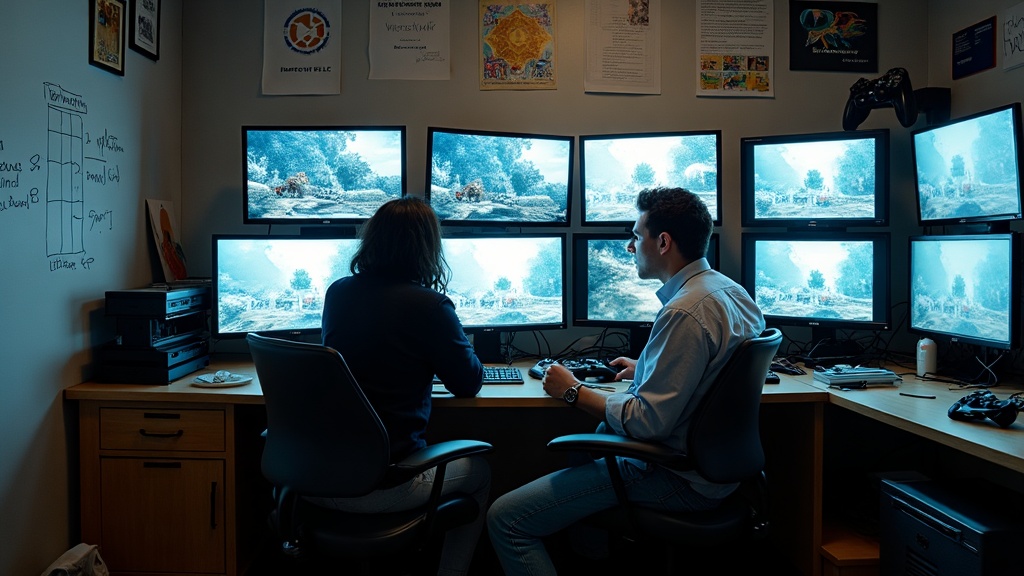
A small bug is cosmetic or annoying but doesn’t stop progress — a texture flickering, an odd animation, a line of dialogue playing at the wrong time. A game-breaking bug can corrupt a save, lock a quest, crash the game, or make progress impossible, and those are the ones that generate the most attention at launch.
Not all bugs are created equal, and outrage online often treats them as if they were. A floating object in the background is not the same category of problem as a save file that becomes unreadable. Studios generally triage bugs this way internally too — the most severe, most common issues get fixed first, and cosmetic oddities may never get addressed at all if they’re rare enough or harmless enough.
- Cosmetic bugs: visual glitches, minor animation errors, audio that plays at the wrong moment.
- Functional bugs: a quest that won’t progress, an item that doesn’t work as intended.
- Critical bugs: crashes, corrupted saves, multiplayer disconnects, or progress-blocking failures.
Reviewers and players often disagree about how much a given bug should matter to a game’s overall reputation, which is part of the bigger pattern explored in why game reviews disagree with each other so much.
§05Why do PC versions sometimes launch buggier than console versions?
PC hardware isn’t standardised the way consoles are. A console has one fixed set of components that every copy of the game runs on, while a PC version has to work across a wide range of graphics cards, processors, memory configurations, and driver versions — any one of which can expose a bug the console version never hits.
This is a genuinely structural difference, not a sign that PC ports are made carelessly. A console maker controls the exact hardware inside every unit sold, so a developer testing on a handful of retail units has effectively tested the whole install base. A PC version has to be tested against dramatically more variation, and no studio can own every graphics card and driver combination that exists. That’s part of why some PC releases need extra patches focused purely on compatibility, separate from the bug fixes the console version needed. Readers weighing a PC build should look at our broader PC gaming and setup coverage, and specifically the difference graphics hardware makes, to understand how much variation studios are actually testing against.
§06Are live-service and online games more prone to bugs?
Yes, largely because they keep changing after launch. Every new update, balance change, or seasonal content drop is a fresh opportunity to introduce a new bug, and the servers themselves can behave differently under real player load than in any pre-launch test.
A single-player game that ships and stays largely unchanged has one moment where it needs to be stable: launch. A live-service game is never really “finished” — it keeps receiving updates for months or years, and each one carries its own risk of breaking something that used to work. Server load is especially hard to test accurately beforehand; a test with a few thousand internal accounts doesn’t necessarily reveal what happens when a much larger number of real players log in simultaneously on day one. For more on how these games are structured and funded, see what a live-service game actually is and how free-to-play games make money, both of which explain why these titles are built to be updated indefinitely rather than shipped once and left alone.
§07Does day-one patching make the problem worse?
It changes the calculation rather than making things simply worse. Because patches are expected, some studios treat launch day as one checkpoint in an ongoing process rather than the final deadline, which can mean less pressure to catch every issue before release.
This isn’t necessarily a bad trade for players. A day-one patch can fix problems that would previously have shipped permanently broken, the way they did on cartridge or early disc releases. But it does mean the incentive to be completely finished by launch day is weaker than it used to be, since there’s a known safety net afterward. Anyone buying at launch versus waiting a few months is effectively betting on how much that particular studio relies on that safety net. If patching and connectivity matter to a purchase decision, it’s worth reading about what happens when a game’s servers eventually shut down, since a heavily patch-dependent game can end up in an odd state once support ends.
§08Should players wait before buying a new release?
Waiting a few weeks or months after launch is a reasonable way to avoid the worst day-one bugs, since most major issues get identified and patched fairly quickly once a large player base is actually playing. It’s a trade-off between being early and being cautious, not a guaranteed fix.
There’s no universal right answer here — it depends on the game, the studio’s track record, and how much a player minds encountering the occasional glitch. Games built on brand-new engines or entirely new online infrastructure tend to carry more risk at launch than sequels using proven, iterated technology. Reading early player impressions rather than only review scores can reveal whether reported bugs are cosmetic annoyances or the kind that block progress. For a broader framework on this decision, see how to decide if a game is worth full price, which covers timing alongside the value question.
§09The bigger picture
Bugs at launch aren’t usually a sign that a studio didn’t care or didn’t try. They’re the visible result of fixed deadlines meeting genuinely unpredictable complexity — more hardware variety, more player freedom, and bigger, more interconnected systems than games had a generation or two ago. Understanding that doesn’t make a broken save file less frustrating in the moment, but it does explain why the pattern keeps repeating across the industry rather than being specific to any one careless team. For more on how games actually get made under these pressures, the how games work hub is a good starting point, alongside our wider industry and culture coverage.