A metroidvania is a side-scrolling or 2D-style game built around one connected map that the player explores gradually, gaining new abilities that open up previously blocked paths. The name is a mashup of two franchises, Metroid and Castlevania, whose games in the 1980s and 1990s established the format almost by accident.
§01What actually makes a game a metroidvania?
A metroidvania is defined less by its setting or story and more by its structure. The core idea is a single, sprawling map rather than a series of separate levels, combined with permanent character upgrades that change what the player can physically do in that space.
Most games in the genre share a recognisable set of ingredients:
- One large, interconnected world instead of discrete stages selected from a menu
- Areas that are visible or reachable early but genuinely impassable until a specific ability is found
- Permanent upgrades — a double jump, a grappling hook, a bomb, the ability to swim or turn into a ball — that double as keys
- Backtracking that feels purposeful rather than repetitive, because the player returns to old areas with new tools
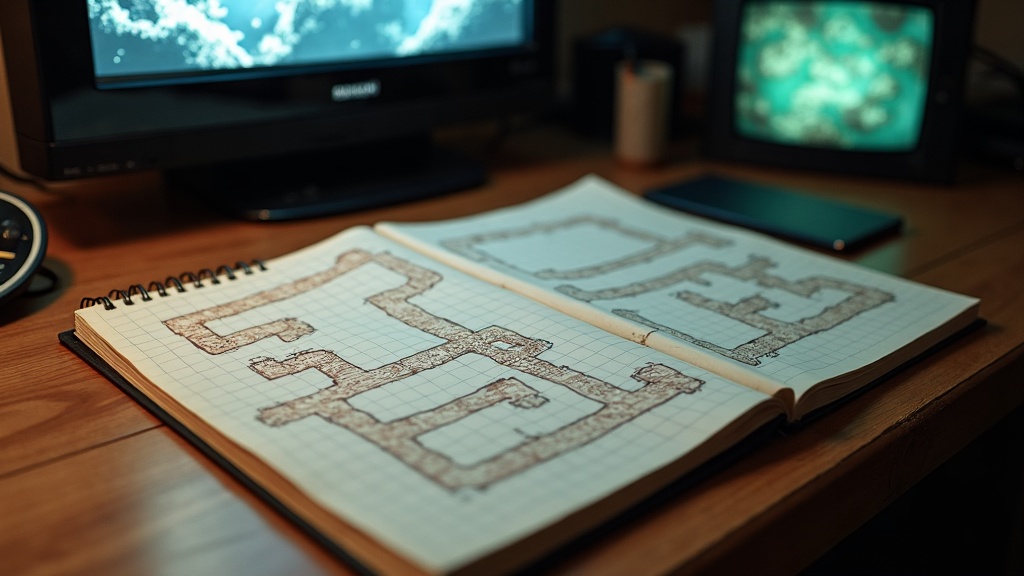
- A map screen the player is expected to consult constantly, often filling in as they explore
That last point matters more than it sounds. Because metroidvanias hide their progression inside the map itself rather than inside a difficulty curve or a story flag, a lot of the pleasure comes from the player’s own sense of orientation — remembering “that ledge I couldn’t reach three hours ago” and realising the new item finally gets them there.
This is different from a straightforward platformer, where levels are typically linear and self-contained, and different from an open-world game, where exploration is usually less about locked gates and more about scale. The genre sits in its own lane, similar in spirit to how roguelikes get grouped by a shared structural rule rather than a shared genre of story.
§02Where does the name “metroidvania” actually come from?
The name is a fan-made blend of Metroid, Nintendo’s science-fiction exploration series, and Castlevania, Konami’s gothic action series, because both franchises produced the games that most clearly established this style of design.
Metroid, released for the NES in 1986, dropped players on an alien planet with almost no hand-holding and a map that had to be learned by exploring it. Movement upgrades doubled as the game’s main form of progression — there was no traditional “level 2, then level 3” structure, just one world the player slowly understood better.
Castlevania had started out as a much more linear, stage-based action series. That changed with Castlevania: Symphony of the Night, released in 1997, which took the gothic castle setting and dropped the linear level structure in favour of a single connected map clearly influenced by Metroid’s approach, complete with ability-gated doors and a map screen players would return to constantly.
Once Symphony of the Night proved that formula could work outside Metroid itself, players and critics online started needing a shorthand for “games structured like these two.” The blended term “metroidvania” grew out of fan and message-board conversation over the years that followed, rather than being coined by either Nintendo or Konami. It is very much a community-invented label, not an official genre name stamped on a box.
Some developers and outlets still resist the word, preferring more neutral terms like “search-action game” (a phrase Konami itself used around Symphony of the Night) or simply “exploration platformer.” But “metroidvania” won out in everyday use because it does something a generic term doesn’t: it points directly at two specific, well-known games, so anyone who has played either one instantly understands the reference.
§03Is a metroidvania the same thing as a roguelike?
No. The two genres are often discussed together because both are structural, rule-based labels rather than settings, but they solve different problems. A metroidvania is about a fixed, memorable map that opens up over time; a roguelike is about runs that end and restart, often with randomised layouts.
Plenty of modern games actually blend the two, generating a metroidvania-style map fresh each run so no two playthroughs unlock the same route in the same order. That hybrid has become common enough that readers looking for a fuller breakdown of the roguelike side of that comparison may find it useful to read a dedicated explainer on what actually defines a roguelike alongside this one.
§04Which games count as the “classic” examples?
Most discussions of the genre point back to the same handful of touchstones, because they either created the format or refined it into something later games kept copying.
- Metroid (NES, 1986) — the game that gave the genre half its name, built around exploring a planet and finding movement upgrades in roughly any order the player can manage
- Super Metroid (SNES, 1994) — widely treated as a high point for the original series, refining the map, atmosphere and item-gating that later games would study closely
- Castlevania: Symphony of the Night (PlayStation, 1997) — the game that gave the genre the other half of its name, bringing role-playing elements like stat growth and equipment into the same exploration structure
- Later Castlevania handheld entries on Game Boy Advance and Nintendo DS, which kept refining the format through the 2000s
These games didn’t appear in a vacuum — they grew out of the broader shift away from arcade-style, level-based design that was already reshaping home console games, a period covered in more depth in our Game History section.
§05Why did the genre nearly disappear and then come back?
For a stretch of the 2000s, big-budget action games moved toward 3D, cinematic set pieces, and more linear pacing, which pushed 2D exploration games like the classic metroidvanias toward the margins of the industry.
The genre’s return is closely tied to the rise of small, independent studios that didn’t need enormous budgets to build a compelling 2D world — a shift discussed at length in our piece on how indie games became a serious part of the industry. Digital storefronts made it realistic for a small team to release a 2D exploration game without needing shelf space at a retailer, and metroidvanias turned out to be a great fit for smaller teams: a single interconnected map can be built incrementally, art style can substitute for graphical horsepower, and the genre’s fans are generally forgiving of modest production values if the map design and controls are strong.
That resurgence produced a new wave of well-regarded metroidvanias through the 2010s and into the 2020s, several of which are now considered as influential within the genre as the games that originally named it. It’s also part of a broader pattern worth noting: long-running franchises regularly reinvent their own structure this way, something explored further in our article on why so many long-running series reboot themselves.
§06How do you tell a metroidvania from a regular action platformer?
The simplest test is whether progress is stored in the map or in the level select screen. If beating a stage just unlocks the next stage, it’s a platformer. If beating an area gives an ability that lets the player walk somewhere they already saw and couldn’t reach, it’s a metroidvania.
A second useful test is backtracking. Traditional platformers rarely expect players to return to an earlier area; metroidvanias are built assuming they will, and often reward it with hidden upgrades, shortcuts, or optional lore. If a game’s map screen is something the player checks constantly and marks up mentally — “come back here once I can double jump” — that’s a strong sign it belongs to the genre.
§07Where should a newcomer start?
Anyone curious about trying the genre for the first time generally has two reasonable paths: play one of the originals that named it, or start with a modern independent title built with decades of genre refinement behind it. Both approaches have merit, and readers weighing whether to chase an original release, a later port, or a remaster of one of the classics may find it useful to read our guide on what a remaster versus a remake actually means for buyers before deciding which version to pick up. Those interested in original hardware and cartridges rather than modern re-releases can also browse our Retro & Preservation section for buying and authenticity advice, and our broader Genres & Recommendations hub for more genre breakdowns like this one.